 Instagram
Screening Programme
Tuesday 2 June - Tuesday 23 June 2026
Danielle Arnaud is pleased to present a curated series of screenings accompanied by discussions.
Booking is essential: please contact danielle@daniellearnaud.com
Doors open at 6pm. The screenings will start promptly at 6.30pm
Tuesday 2 June
Keira Greene
The screenings will be followed by a discussion with
Maria Walsh
Eustatic
Drift
2018
8' 37"
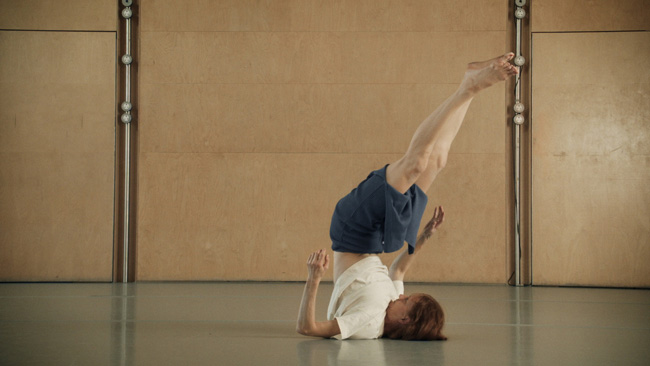
Keira Greene Eustatic
Drift
2018
HD video, 16
minutes 9 seconds, colour, stereo. Image courtesy of
the artist.
“once we were
plankton slouched in the ocean but now we are code, surfaced
and held in the laminae of rock like open scores.”
This
narrative voice comes to us from the fossils of Graptolites,
our long extinct plankton ancestry. Their speculative voice
speaks to us from within deep time as they coil past and
future, blending evidence of our interspecies story. In
Eustatic Drift we experience the real and imaginary
potential of the Graptolites, as a tangible index of a once
dominant species, and as a latent oracle. The film opens
with wide images of the remote landscape of Dobs Linn,
Scotland, significant for its graptolite-bearing strata.
[…]
In a studio environment dancer Katye Coe performs the
Graptolite as an open score. She unfolds the rock and
imagines how the species may have moved. In one instance we
read in their script: “perhaps we were swimming?”
Keira Greene
x comme x 2017
3'
6"
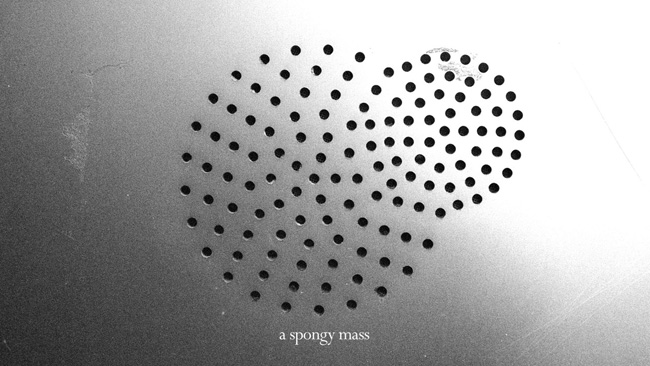
Keira Greene
x comme x 2017 3
minutes 6 seconds. Image courtesy of the artist.
x
comme x delivers a narrative text in which we hear incarnate
words speak to the deep time that the geological fossil
record offers. The text spoken on the film, which imagines
cross-temporalities that extend from the contemporaneous, is
a response to the visible strata of time recorded in a gorge
in southern Scotland.
x comme x suggests an equivalence
in time in which chronological duration and myth—measured
both geologically and semantically—are given new sonic
rhythms and visual patterns.
x comme x was translated
into French by Fatima Djabri and Des Brennan. The text is
performed by Fatima Djabri.
Keira Greene is an artist working across film,
installation, photography and performance. Her work is
preoccupied with the social and organic life and landscape
of specific environments. Her practice is produced through a
collaborative and conversational approach of looking,
writing and forming enduring relationships. Recent works are
concerned with ideas of the body and the experience of
emotion, in dialogue with an embodied filmmaking practice.
Recent screenings and exhibitions include Close-Up, London
(2026), The Model, Sligo (2025), International Film Festival
Rotterdam (2025), Arnolfini, Bristol (2024), Docs Ireland,
Belfast (2024), International Film Festival, Cork (2024),
Beursschouwburg, Brussels (2024), Site Gallery, Sheffield
(2023), La Chapelle de l’Oratoire – Musée d’arts de Nantes,
Nantes (2023), Arcade, Brussels (2022), Kelder, London
(2022), Arko Art Center, Seoul (2022)... Arcade, Brussels
(2021), Sofia Art Projects, Sofia (2021), Café Oto, London,
(2020), Stanley Picker Gallery, London (2019), LUX, London
(2019), Cubitt, London (2018), Jerwood Space, London,
(2018).
Maria Walsh is Reader in Artists’ Moving Image
at Chelsea College of Arts/UAL, and author of Therapeutic
Aesthetics: Performative Encounters in Moving Image Artworks
(Bloomsbury, 2020), a monograph exploring toxicity and the
curative in artists’ film and video in a context of
neoliberal cognitive capitalism. Recent publications include
book chapters: ‘The Space of Thirdness: Intermediating
Performative Treatments in Artists’ Moving Image’ in
Audiovisual Healing and Reparation: Recuperative Affect of
Mediation, (Routledge, 2025), and ‘Affective Impingements in
Nina Cristante’s The Richest Man… and Ilona Sagar’s
Correspondence 0’ in Affect and Neoliberalism, (Routledge,
forthcoming 2026). She is also an art critic,
contributing to Art Monthly, Burlington Contemporary, e-flux
and Third Text Online. Her research interests lie at the
intersection of art and film, and philosophy and
psychoanalysis through a feminist lens. She is currently
researching the poetics of the essay form in practice.
Tuesday 9 June
Susan Francis
We Are Multi-Storey Creatures
2026
Single channel video installation
18' 37" 2026
The screening will be followed by a discussion
between the artist and Mark Dean
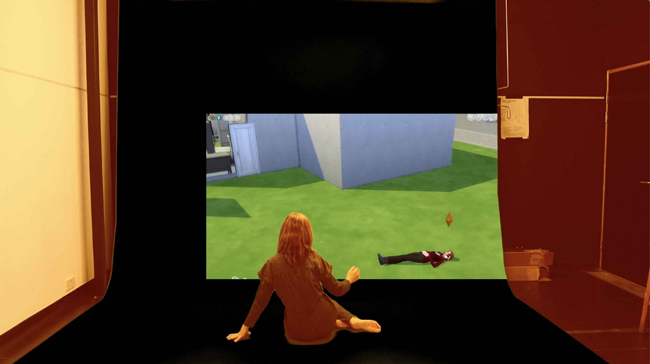
Susan Francis We Are Multi-Storey
Creatures
2026.
Single channel video installation 18 minutes 37 seconds.
Image courtesy of the artist.
We are Multi-Storey Creatures sees the artist
attempt to enter the online world and join her digital
counterpart. Power shifts between the characters as a
relationship between the gamer, their online presence and
the SIMS avatar, Alice, fluctuates between indifference,
frustration, and fleeting moments of connection. Building an
ever-expanding house for the character, the artist becomes a
sort of analogue Virgil to Alice’s digital Dante, leading
the character from depression and disengagement to
re-enchantment and transcendence as she ultimately ascends
through the lived space. Dabbling in cloud symbolism from
mediaeval mysticism to digital skeuomorphism, this is
orchestrated through the introduction of a cloud chamber, a
home-made particle physics experiment capable of revealing
the immaterial and subatomic activity within the house.
In her 1929 book, The House of the Soul
theologian and mystic Evelyn Underhill wrote, ‘We are two
story [sic] creatures’, reinforcing the dualist nature of
the embodied spirit. As the fragmented self continues to
extend across ever more multiplicitous platforms this work
questions if the term multi-storey creatures may prove more
appropriate, or is the divide between the material, the
digital and the immaterial still a gulf we have yet to
overcome.
Susan Francis is a Belfast born artist
with a practice that focuses largely on film, sculpture and
installation. Past international exhibitions and residencies
include the Center of Polish Sculpture in Oronsko, The Bemis
Center for Contemporary Arts in Nebraska, and ‘Cicatrix
Imprimé’ at Atelier Circulaire in Montreal, Canada in 2018.
She has received a number of awards from Arts Council
England, the British Council, the Gane Trust, and the Juliet
Gomperts Trust. Her films have been shown at numerous venues
including Chisenhale Art Space, Coexist galleries, and
Bermondsey Project Space. Recent exhibitions include
Insect Odyssey at Salisbury Museum in 2022, the touring
exhibition, Drawing the Night In, in 2024-25, and
Perpetual Bendhu a solo exhibition at CAS, Andover,
Hampshire in 2025. As a member of the Royal Society of
Sculptors her work has also been selected for exhibition in
their London gallery in 2023, 24 & 25. With a master’s
degree in theology, imagination and culture, Susan Francis
is currently studying a practice-based PhD at Winchester
School of Art, entitled ‘Walking Through Walls’. She also
has work held in public and private collections in the UK,
North America and in the Arts Council Collection of Northern
Ireland.
Mark Dean began looping appropriated film
while studying photography and painting in the late 1970’s,
and in the 1980’s extended this technique into music; these
practices were eventually combined in the methodology for which
Dean became recognised as a video & sound artist from the
1990’s onwards, with work held in collections including Arts
Council of England, Leeds Art Gallery, MUDAM Luxembourg, and
EMMA Finland. Music has remained an integral part of Dean’s
art practice, with looped and layered sound samples often providing
the structural basis for video works. This treatment of music
as primary material is paralleled by a consistent use of film
as objet trouvé; however, Dean’s use of appropriation differs,
at least from some of the more reductive interpretations of
such work, in that it is based not on a theory of the emptiness
of images, but on a theology of kenosis, or self-emptying; a
practice grounded in the lived experience of trauma.
Working via the gallery system in the 1990’s and 2000’s,
Dean was ordained in 2010, and following this has produced cross-disciplinary
and collaborative events. In 2021 Dean began publishing video
albums on chaplachap records; while referencing vinyl LPs and
EPs, they also recall a time when video artists conceptualised
a future of dematerialised art, distributed outside of commodification
systems. The technology to realise this eventually arrived,
but along with it came both a shift in patterns of consumption
and a convergence of media, such that ‘video art’ may no longer
exist beyond its own history; and yet here we are…
Friday 12 June
Cathy Sisler
The screenings will be followed by a discussion between Miriam Rafael Sampaio and Althea Greenan
The Better Me 1995
Video, 20'
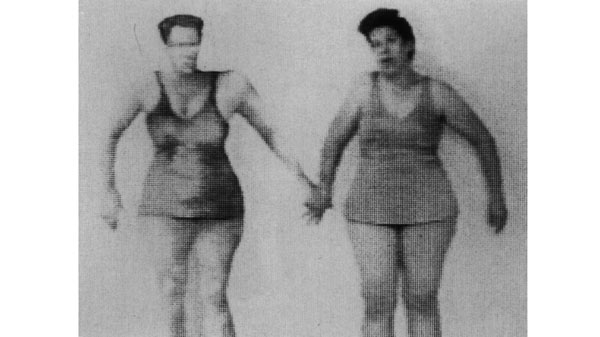
Cathy
Sisler The Better Me 1995, Canada Video, 20 minutes SD
Digital file. Image courtesy of the artist.
Using the codes of TV, halfway
between an commercial, a talk show and a therapy session,
the artist humorously reflects upon the transformation and
appreciation of self. A ghostly presence progressively seeps
in. ‘It is possible to invent someone who will be with us
all our lives (…) She stands over there watching me.
Watching me with those eyes. One look back into her eyes
watching me makes me question everything I do and say. (…)
She invented herself as separate from me because she knew
our integrity was in danger here. And now, our separation is
our integrity. She has the body of a particular adolescent
girl: my body… then.’
Cathy Sisler
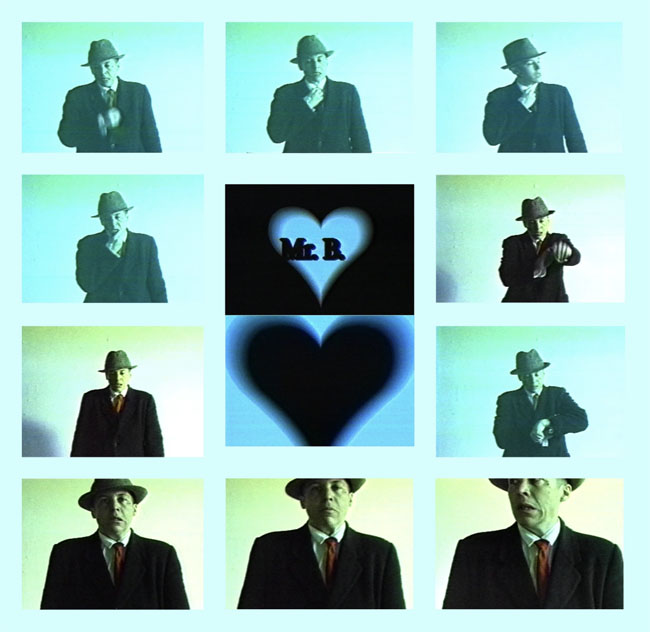
Mr. B 1994
Video, 7'
Cathy
Sisler Mr. B 1994 Video, 7 minutes. DVD / Digibeta
tape / SD Digital file. Image courtesy of the artist.
Mr B is the romantic male alter-ego of Cathy Sisler. Through dress and gesture she recreates herself on the streets of the city. Archetypal movement and poses reveal the transparency of identity formed through visual reference. The romantic music urges the viewer to narrativise the scenes, highlighting the manipulative process of the medium.
Cathy Sisler
Aberrant Public Speaking 1994
Video
with sound, 18'
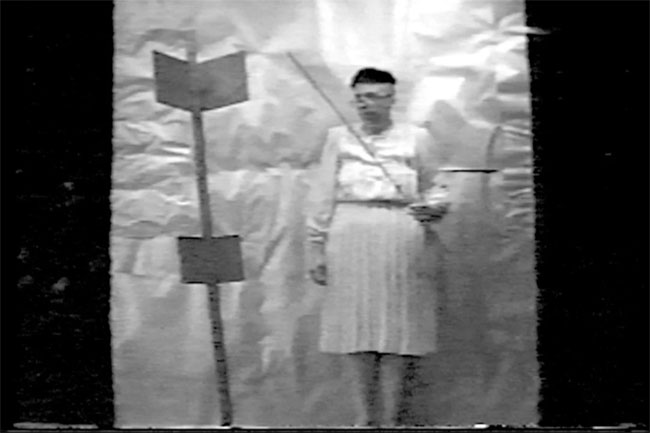
Cathy Sisler Aberrant Public Speaking 1994, Canada
Video with sound, 18 minutes. Image courtesy of the artist.
The Spinning Woman decides she needs to further increase her social skills, and embarks on the task of becoming a better public speaker. This video begins to look at the more blatant excesses, and subtle psychological responses, to the social pressures of self-promotion and self-commodification.
Cathy Sisler
Aberrant
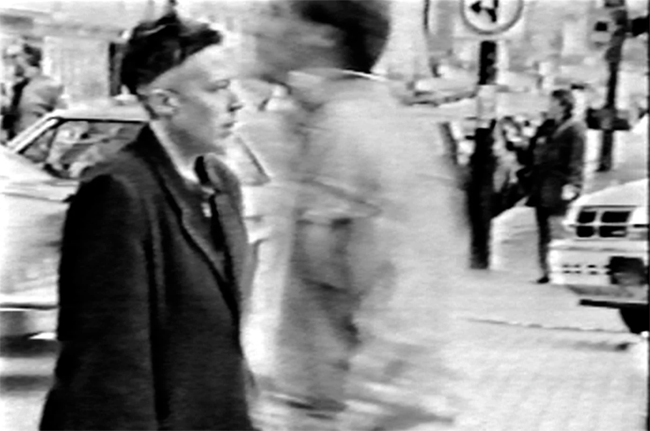
Motion #4 (Face Story, Stagger Stories) 1993
Performance, 14' 31"
The screenings will be followed by a discussion with
Miriam Rafael Sampaio and Althea Greenan
Cathy
Sisler Aberrant Motion #4 (Face Story, Stagger Stories)
1993. Veideo with sound, 14 minutes 31 seconds. Image
courtesy of the artist.
Face Story. An ironic story about a body which has lost control over its closest associate: the face. Stagger Stories. Walking to dissolve the rage and buried anger left by having had to learn to walk so as not to attract attention, to become integrated. ‘I don’t remember it , but I know there was a time when I could neither walk nor talk. Then walking and talking became these ongoing obsessions which I totally took for granted as being normal.
Cathy Sisler (1956-2021) was born in
Wisconsin (USA) and based in Canada since 1965. Cathy Sisler
was a videographer, musician, performer, painter and writer.
During the 1990s and at the beginning of 2000, she created
different characters: the Spinning Woman, the Staggering
Woman and the Falling Woman. Her work raises the question of
a fragility that is explored through the notion of the
double and the marginalized body. She won the Jury Prize at
the Festival du cinéma et des nouveaux médias (Montreal,
1997), and was nominated for best video at the 16th
Rendez-vous du cinéma québécois (Montreal, 1997). Her video
The Better Me (1995) is part of the permanent
collection of the National Gallery of Canada. Recently Cathy
Sisler worked for Start Me Up Niagara, a shelter
for the homeless, where she collaborated with the Art
Garage, a space where street people are invited to create,
make art and express themselves without constraint or
judgement.
Miriam Rafael Sampaio is an interdisciplinary artist working with photochemical film, photography, photo-etching and installation, an independent curator and researcher. She is a Sephardic Portuguese Jewish Roma queer woman of colour born in Montréal and holds an MFA from Concordia University. Sampaio’s practice embodies ‘camadas’ - in Portuguese ‘layers’ or ‘palimpsests’ which reflect and embody epigenetic memory, trauma, loss, the (in)visible traces these leave on and in the individuated bod(ies) and philosophical lines of enquiry they inevitably pose. Her work has been shown in Europe, the USA, Canada and Mexico and has been recognized with awards from the Canada Council for the Arts, Arts Council England and the Calouste Gulbenkian Foundation amongst others. Her video work is distributed by Groupe Intervention Vidéo (GIV) in Montreal.
Sampaio’s 2023-2024 project with the personal book collection of Helen Chadwick recently donated to the Women’s Art Library, catalysed her interest in the archive space as a feminist strategy to secure access to critical artwork. Since then, she has liaised with networks in Canada to create a research resource collection dedicated to the work of Cathy Sisler in the Women’s Art Library. She met Cathy when the artist was a postgraduate student in Open Media at Concordia University’s and doing activist work for the Women’s Centre there.
Dr Althea Greenan works in Special Collections and Archives at Goldsmiths, University of London and curates the Women’s Art Library (WAL) collection. She programmes artistic research supporting artists, students and academics and this work is the subject of a film by Holly Antrum commissioned by the Art360 Foundation titled Yes to the Work!: The Women’s Art Library. Additional roles include co-curating the Animating Archives website and advising the Feminist Art Making Histories, oral history, digital humanities project, funded by the Irish Research Council and the AHRC.
The Women’s Art Library (WAL) is a collection of photographic, ephemeral, personal and published art documentation initiated by women artists in the late 1970s. Thriving as an artists’ organization and publishing a magazine until 2002, the collection was then gifted to Goldsmiths and forms part of its Special Collections where it continues to collect and support artistic research, teaching and a feminist ethics in archive work.
Groupe Intervention Vidéo (GIV) Founded in
Montreal in 1975, is one of the few centers in the world
dedicated to the preservation and promotion of media
artworks by women (women is used here in the most inclusive
sense of the term), distributing and disseminating them
while actively supporting production. Anchored in an
intersectional approach, GIV supports artists of different
ages, backgrounds and communities, and the practice of media
arts in its various forms and currents, both artistic and
action-oriented.
Its distribution catalogue reflects
a plurality of approaches and treatments and bears witness
to the multiple social, technological and artistic
transformations of our world and the constant redefinition
of our identities. The catalogue currently features 1,950
works by 490 artists from Quebec, Canada and abroad.
Throughout the year, GIV organizes year-round programming
and creative activities in collaboration with artists from a
variety of disciplines, guest curators, festivals and
community organizations, as well as streaming a wide range
of digital works. GIV’s policy is to pay royalties and
artists' fees for all its activities.
With the kind support of Groupe Intervention Vidéo (GIV).

Tuesday 16 June
Tessa Farmer and Sean Daniels
Nest of the
Skeletons 2008
Stop motion animation
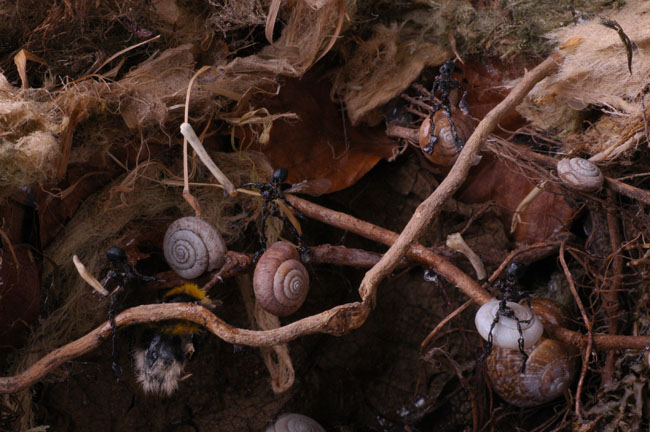
Tessa Farmer and Sean Daniels
Nest of the Skeletons, 2008, 5 minutes, 50 seconds, stop motion animation.
Image courtesy of the artist.
Nest Of the Skeletons plays brilliantly on the paranoid fantasies of parasitic invasion and colonization that the proximity to insects often evokes. The film zooms us in to the limply hanging body of a straw scarecrow to reveal one version of the origin and birth of her fairies. Nest of the Skeletons was commissioned by Parabola for The Tatton Park Biennial 2008.
Tessa Farmer and Sean
Daniels
The Den of Iniquity 2010
Stop motion animation
The screenings will be followed by a conversation between the artist and Victor Rees

Tessa Farmer
and Sean Daniels
The Den of Iniquity 2010. Stop motion animation, 5
minutes 21 seconds. Image courtesy of the artist.
The Den of Iniquity (2010) by Tessa Farmer and Sean Daniels was
commissioned for the exhibition Extraordinary Measures
at Belsay Hall, Northumberland and shown alongside Tessa's
outdoor installation A Darker Shade of Grey.
Tessa Farmer was born in Birmingham (1978)
and now based in London. Farmer studied Fine Art at The
Ruskin, University of Oxford. She creates intricate
sculptures, installations and occasional stop motion
animations, from organic materials and is best known for her
macabre skeletal fairies, a malevolent species that has been
steadily evolving within her practice since the late 1990s.
In 2007 she was artist in residence at the Natural History
Museum in London and was nominated for The Times/ Southbank
Show Breakthrough Award. In 2011 she was awarded a Kindle
Project 'Makers Muse' Award and in 2015 won the British
Science Fiction Association BSFA Art Award. Recent
exhibitions include ‘Welcome to Fairyland’ (solo), The
Viktor Wynd Museum of Curiosities, London, 2025, ‘Occupied:
Strange Company’ (May 2026) at The Safehouses, Peckham,
‘Elective Affinities: Centenary Exhibition’ Swedenborg
House, London, 2025, ‘Common Creatures, Bewildering Beasts’,
KH7 Artspace, Aarhus, Denmark, 2025 and ‘Kafka: Making of an
Icon’, Weston (Bodleian) Library, University of Oxford,
2024. Her work can be seen in the permanent collections of
MONA, Tasmania and The Viktor Wynd Museum of Curiosities,
London.
‘In Fairyland: The World of Tessa Farmer’ was
published by Strange Attractor Press in 2016. Edited by art
historian and curator Catriona McAra, In Fairyland consists
of eight carefully crafted chapters by Giovanni Aloi,
Gail-Nina Anderson, Gavin Broad, Brian Catling, Jeremy
Harte, Petra Lange-Berndt, and John Sears.
Victor Rees is a London-based writer,
performer and academic whose work explores the intersection
of the mystic and the grotesque. His short stories and
articles have been published by Textual Practice, Swedenborg
House, Albion Village Press and The Friends of Arthur
Machen. He collaborated on the children’s alchemical primer
_This into That_ (Child Be Strange, 2025) with
world-renowned illustrator Monika Beisner. Another picture
book, _The Lamb & The Cockatrice_ , is due to materialise
soon. With Iain Sinclair he co-edited _A Mystery of Remnant
and Other Absences_ , a collection of Brian Catling’s short
stories published by Swan River Press. In 2025 he completed
a PhD at University College London entitled _The Mystic and
the Visionary in the works of Brian Catling_ .
Tuesday 23 June
Neville Gabie
At Sea 2026
Video,12' 24"
The
screening will be followed by a conversation between the
artist and David Cotterrell
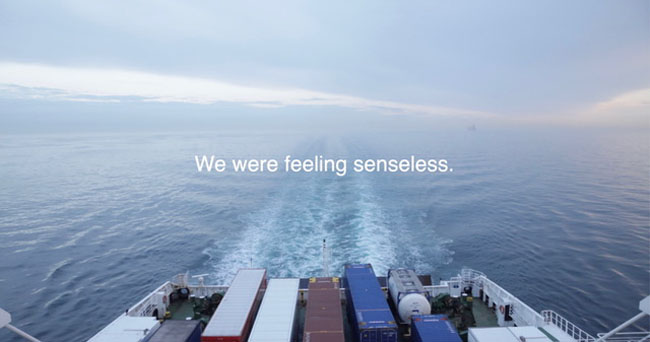
Neville
Gabie At Sea 2026. Video, 12 minutes 24 seconds.
Image courtesy of the artist.
At Sea, commissioned by Hull Maritime Museum, focuses on the harrowing journeys of three unaccompanied child migrants. Whilst awaiting processing, the artist got to know them - in limbo. Simultaneously he was involved with documenting fulmars; birds which make vast journeys over oceans in search of food.
The tenacity of fulmars - their endeavour, echoes the trauma of these young migrants, hounded by police, used by traffickers, confronted by borders without family and literally ‘at sea’. Hull was a gateway for over two million mainly Jewish refugees in the early 1900’s. Ironically that included the artist’s own family, the insecurity of these particular boys becoming strangely personal. At Sea has been shortlisted for the Aesthetica Art Prize 2026 and will also be installed in the refurbished Maritime Museum due to open this summer.
With a background in sculpture, Neville Gabie’s practice has always been driven by working in response to specific locations or situations caught in a moment of change. Highly urbanized or distantly remote, his work is a response to the vulnerability of place. Gabie’s interest is in establishing a working relationship within a particular community as a means of considering its physical, cultural or emotional geography. Born in Johannesburg, South Africa – MA in Sculpture at the Royal College of Art, London 1986/88. At Sea has been selected for the Aesthetica Art Prize 2026 and will be exhibited in York from mid-July.
David Cotterrell is an installation artist who uses various media and technologies to explore the social and political tendencies of a world that is simultaneously shared and divided. An interest in the intersection typifies the practice: whether fleeting encounters or heavily orchestrated events, Cotterrell’s works explore the human condition and the breaks or nuances that can lead to a less ambiguous understanding of the world they inhabit. Encapsulating the roles of programmer, producer, and director, Cotterrell develops projects that embrace the quiet spaces that are the sites for action. Cotterrell’s work has been commissioned and shown extensively in Europe, the United States and Asia. He is a Research Professor of Fine Art at Sheffield Hallam University.